Muscle group
Upper back exercises
The upper back is everything that pulls the elbow in toward the torso and draws the shoulder blades together: rows in every form, plus shrugs for the traps. Unlike the lats, where the load comes from overhead, here the movement runs horizontally - to the chest, to the stomach or to the hip.
There are more variants here than in most other body parts, because every piece of equipment does the same job a little differently. A barbell lets you move the most weight, but it asks you to hold the bent-over position for the whole set. A supported dumbbell and a seated cable take that requirement away, so all that is left is the pull.
Upper back exercises by equipment
Choose the equipment available to you and find exercises that suit your setup.
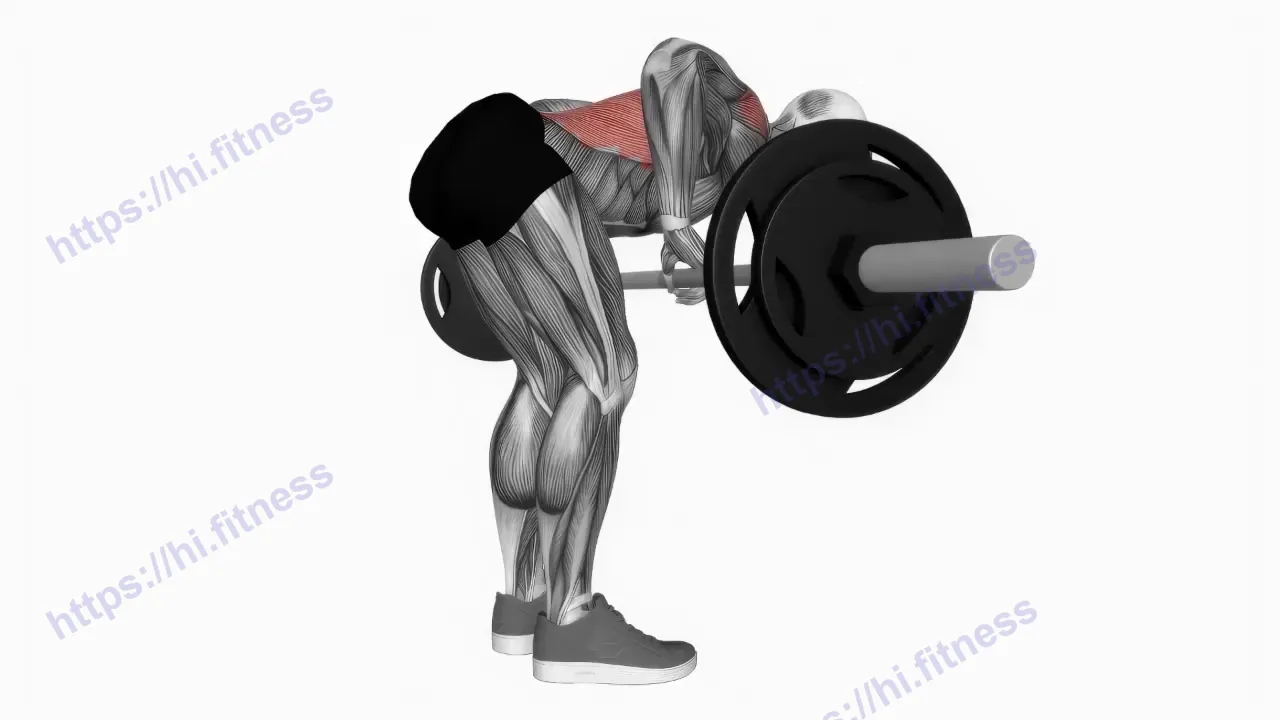 The most weight in a rowCable17
 Constant tension, seated or standingDumbbell15
 Each side works on its own
More equipmentBench 13·Resistance band 8·Suspension trainer 5
Exercise library
All Upper back exercises
68 exercisesFilters
Filters
Equipment
Training type
Dumbbell Bent-over Row
Upper back · Dumbbell
Seated Cable Row V Bar Machine
Upper back · Cable

Barbell Pendlay Row
Upper back · Barbell

Cable Low Seated Row
Upper back · Cable

Barbell Shrugs
Upper back · Barbell

Dumbbell Shrugs
Upper back · Dumbbell

Landmine Row
Upper back · Barbell

Barbell Bent Over Row Pronated Grip
Upper back · Barbell

Dumbbells Bent Over Row Pronated Grip
Upper back · Dumbbell

Bent-over Row with Bar
Upper back · Barbell

Inverted Rows on Smith Machine
Upper back · Smith machine

Cable Bent Over Row
Upper back · Cable
Training guide
About training Upper back exercises
Choose one movement, perform it well, then progress it over time.
Where do you pull the weight?
The catalog is surprisingly precise here and it is worth reading closely. The bent-over barbell row brings the bar to the lower chest, the Pendlay version to the stomach, the seated cable row to the lower abdomen, and the one-arm dumbbell row toward the hip. These are not the same movement described in different words.
The higher the pull finishes, the further the elbow travels from the torso, and the more work lands on the mid back and the rear delt. The lower it finishes, the closer the elbow stays to the ribs, and the bigger the share the lats take. That is why plenty of programs carry one movement from each end of that range instead of three versions of the same one.
What they all share is how the rep ends. Squeezing the shoulder blades together at the top shows up in the catalog on the barbell row, on the Pendlay version and on the seated cable. If the shoulder blades never move, the arms are doing most of the pulling and the back is only holding position.
Why shrugs on their own?
Shrugs are the only movement in this group where the elbow stays straight the whole time. The shoulders travel straight to the ears and straight back down, and the work goes to the upper traps - the part rows load in passing, but never as the main target.
There is no shortage of variants: barbell in front and behind the back, trap bar, dumbbells on an incline bench face up and face down, even overhead. What mostly separates them is the angle the weight hangs at relative to your torso, and therefore where in the range the movement gets hardest.
Whether you need them at all depends on the rest of your program. Heavy rows and deadlifts already load the traps just by keeping the weight in your hands, only without moving. Shrugs add work through the full range of the shoulder, which neither of those movements does.
Explore further
Browse the exercise library
Browse by muscle
Upper chest·Mid chest·Lower chest·Lats·Upper back·Lower Back·Front delts·Side delts·Rear delts·Biceps·Triceps·Forearms·Quads·Hamstrings·Glutes·Calves·Core
Browse by equipment
Bodyweight·Dumbbell·Bench·Barbell·Resistance band·Cable·Machine·Squat rack·Other·Mat·Box·Suspension trainer·Stability ball·Kettlebell·Cardio machine·Pull-up bar·EZ bar·Ab wheel·Weight plate·Roman chair·Smith machine·Dip bars·Jump rope·Medicine ball
Browse by type
Add this exercise to a workout and track your progress
Add it to a plan or to your current session, log sets, weight and reps, keep the instructions and tips at hand while you train, and check your previous results, records and volume.
- Plan - add this exercise to a workout
- Log - sets, weight and reps
- Progress - history, records and volume