Equipment
Cable exercises
A cable station is a weight stack tied to a cable. A dumbbell and a barbell always pull straight down; a cable pulls whichever way you route it - and you are the one routing it, by picking the pulley height, the handle and the spot you stand in.
That is why the same flye shows up in the atlas separately as a high, a mid and a low version, even when the handle is identical. Before you pick an exercise by name, read the first step of the description: it tells you where to clip the handle, and it decides where in the range the work is hardest.
Cable exercises by muscle group
Pick the muscle group you want to train and see which exercises cover it.

More muscle groupsBiceps 13·Mid chest 9·Side delts 6
Exercise library
All Cable exercises
105 exercisesFilters
Filters
Muscle group
Training type

Cable Overhead Extension Rope
Triceps · Cable

Biceps Curl Cable
Biceps · Cable

Cable Individual Glute Kickbacks
Glutes · Cable

Seated Cable Row V Bar Machine
Upper back · Cable

Cable Assisted Inverse Leg Curl
Hamstrings · Cable

Cable Machine High to Low
Mid chest · Cable

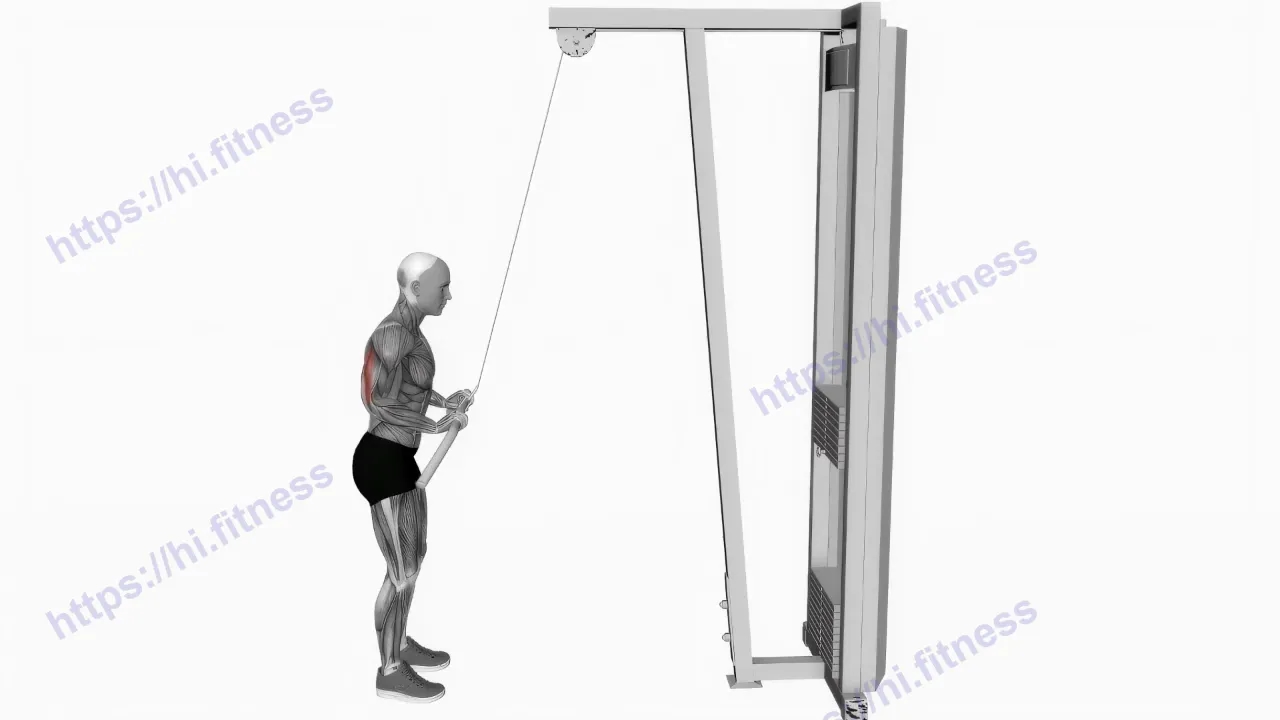
Cable Triceps Push Down Straight Bar
Triceps · Cable

High Cable Kneeling Crunch
Core · Cable

Lat Pull Down Wide Grip
Lats · Cable
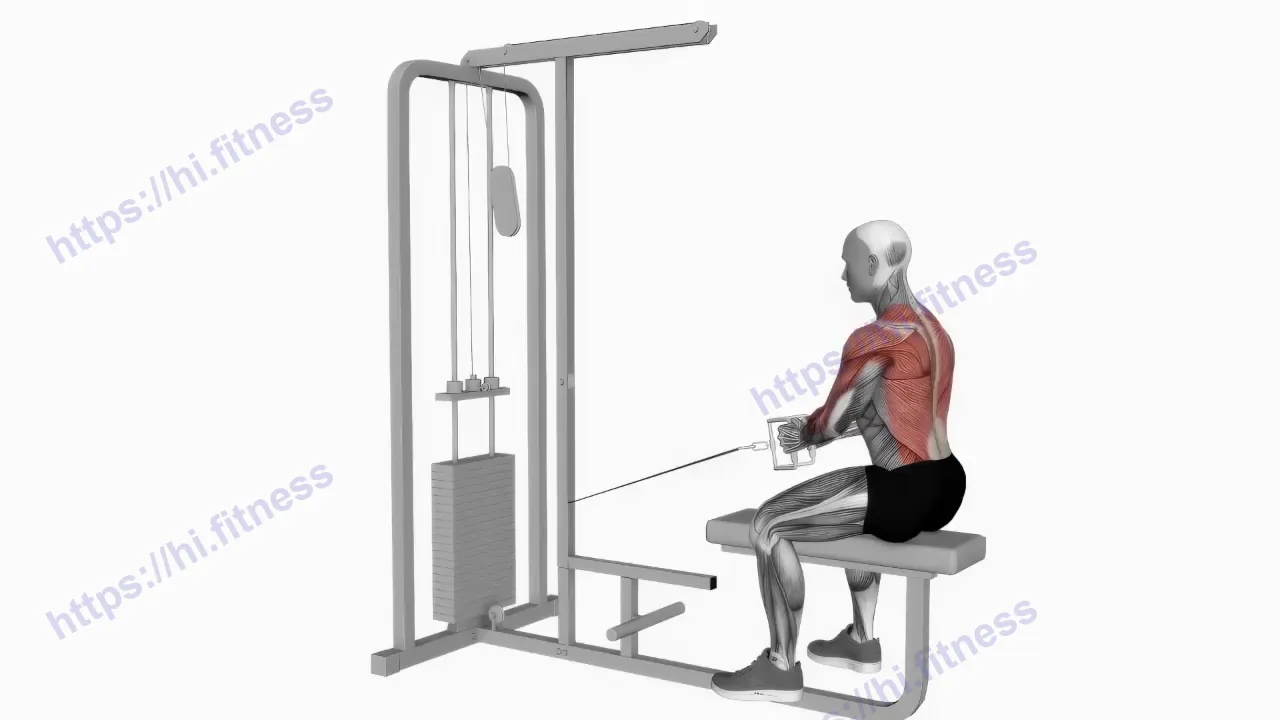
Cable Seated Row
Upper back · Cable

Cable Lateral Raises
Side delts · Cable

Reverse Grip Lat Pull Down
Lats · Cable
Training guide
About training Cable exercises
Choose one movement, perform it well, then progress it over time.
Why the line of the cable is what makes the exercise
With a free weight, what decides where a movement is hardest is how your body sits relative to vertical, because gravity only pulls one way. On a cable you pick that direction yourself. The same handle clipped high, at chest height and down by the floor loads three different pieces of the same arc, and the name of the exercise changes along with the anchor.
The second consequence is that tension never disappears anywhere in the range. On a dumbbell curl the weight hangs over your elbow at the top and the muscle gets a split second of relief. A cable pulls the same at every height, so there is no break - hence the way a set feels afterward, and hence how popular cables are at the end of a session.
The third thing is purely practical: a cable gives you resistance where a free weight cannot. A pull-through loads hip extension horizontally, a kickback has something to work against while you stand, and taking your arms back over your head keeps tension on the lats through the whole arc. You cannot reproduce any of those three with a dumbbell in a way that makes sense.
Which handle should you pick?
In the exercise names in this atlas the handle sits right next to the setup: straight bar, V-handle, rope, EZ bar, stirrups. A straight bar holds your wrists in one position and usually lets you use the most weight. A rope lets your hands separate at the end of the movement and rotate your wrists, which on pushdowns or kneeling pulldowns simply feels better to a lot of people. A V-handle puts your hands in a neutral position, and an EZ bar is the compromise for wrists that a straight bar bothers.
Stirrups are their own category, because they force you to work one side at a time. Beyond the comfort, that gives you simple feedback: at the same weight you see immediately which side finishes the set first. If your gym only has a few handles, a straight bar plus a rope will cover most of the positions on this list.
One last detail that saves a lot of confusion: the number on the stack does not travel between gyms. Cable stations differ in how the pulleys are geared, so twenty kilos on one machine is not the same as twenty on another. Compare your results within one station, not between clubs.
Progress the movement
Work out what one plate is worth
The same stack is a small step on a lat pulldown and a very big one on a single-arm lateral raise. Before you decide how to add weight, check what fraction of your working weight one plate actually is.
When the jump is too big, change the line of pull
Moving the pulley one hole shifts the hardest point of the movement without touching the weight. That is an axis a barbell does not have, and usually a better step than jumping a whole plate.
Use the fact that the stack changes in a second
You move the pin without putting the handle down and without leaving your position, so a set can keep going after the weight stops moving. That is why drop sets are mostly done on cables.
Explore further
Browse the exercise library
Browse by muscle
Upper chest·Mid chest·Lower chest·Lats·Upper back·Lower Back·Front delts·Side delts·Rear delts·Biceps·Triceps·Forearms·Quads·Hamstrings·Glutes·Calves·Core
Browse by equipment
Bodyweight·Dumbbell·Bench·Barbell·Resistance band·Cable·Machine·Squat rack·Other·Mat·Box·Suspension trainer·Stability ball·Kettlebell·Cardio machine·Pull-up bar·EZ bar·Ab wheel·Weight plate·Roman chair·Smith machine·Dip bars·Jump rope·Medicine ball
Browse by type
Add this exercise to a workout and track your progress
Add it to a plan or to your current session, log sets, weight and reps, keep the instructions and tips at hand while you train, and check your previous results, records and volume.
- Plan - add this exercise to a workout
- Log - sets, weight and reps
- Progress - history, records and volume