Muscle group
Lat exercises
The lats pull the arm down and in toward the torso. So every movement in this part of the atlas comes down to one of two things: you pull a weight down to yourself, or you pull yourself up to the bar. Everything else, meaning grip, hand spacing and handle type, only shifts the emphasis inside the same pattern.
Equipment usually settles the choice. A lat pulldown lets you set the resistance below your bodyweight, so it is the easiest place to learn the movement. A pull-up bar gives you a load you cannot dial down, but there is nothing to set up either. A resistance band and suspension straps rebuild the same pattern outside the gym.
Lat exercises by equipment
Choose the equipment available to you and find exercises that suit your setup.


More equipmentMachine 8·Resistance band 8·Bench 7
Exercise library
All Lat exercises
74 exercisesFilters
Filters

Pull Up Wide Grip
Lats · Pull-up bar

Lat Pull Down Wide Grip
Lats · Cable

Chin Up
Lats · Pull-up bar

Reverse Grip Lat Pull Down
Lats · Cable

Lat Pull Down Close Grip
Lats · Cable

V Bar Lat Pull Down
Lats · Cable

Assisted Pull Up
Lats · Machine

Straight Bar Cable Pull Down
Lats · Cable
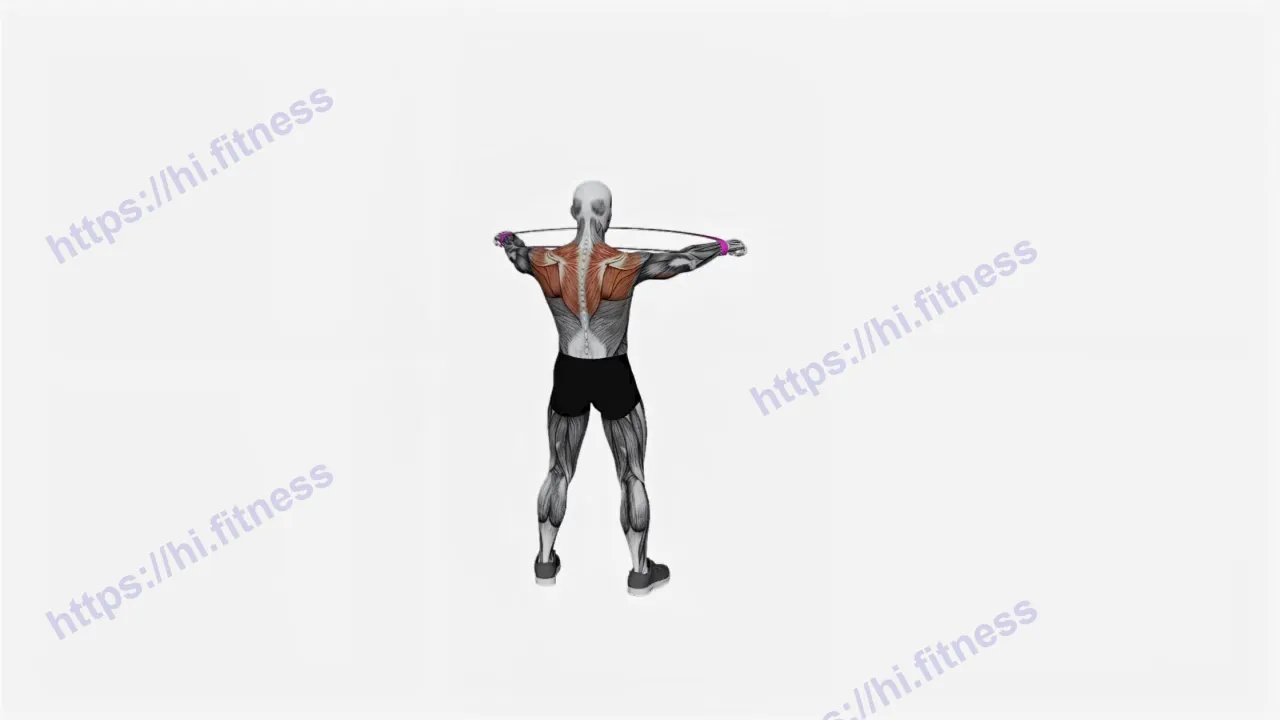
Resistance Band Pull Apart
Lats · Resistance band

Cable Pulldown
Lats · Cable

Cable One Arm Lat Pulldown
Lats · Cable

Assisted Pull Up Normal Grip
Lats · Machine
Training guide
About training Lat exercises
Choose one movement, perform it well, then progress it over time.
Pull-ups or pulldowns?
The pattern is the same, the load is what differs. On the cable you pick the weight, and moving the pin one notch takes you well below your bodyweight or well above it. On the bar the load is you, and that is a number you cannot make smaller - which is why the atlas carries so many assisted versions.
Past the load, the difference is in what else has to hold. On the pulldown you sit with your knees locked under the pads, so your torso stays put and it is easier to feel your back. On the bar you add bracing through the midsection and grip, which for plenty of people gives out first, before the back is anywhere near tired.
Grip shifts the emphasis in both families. Chin-ups give the biceps the biggest share and usually the most reps, a wide overhand grip works the arm more from the side, and a neutral grip spares a lot of wrists. The behind-the-neck version is in the atlas too, but it asks for real shoulder mobility and for some people it is simply uncomfortable.
What if you can't do a pull-up yet?
The atlas has a few answers, and all of them keep the same movement. The assisted machine takes part of your bodyweight off with a counterweight you set like any other load. A band looped under your knee does the same thing for less money, and it happens to help most at the bottom, which is where it is hardest.
The other route is the lowering half on its own. The catalog has a version built on holds and negatives: you get to the top with a jump or a push from your legs, then lower yourself as slowly as you can. There is also a pull-up with a foot on a bench, where the leg adds exactly what is missing, and a TRX row, where you set the difficulty with your body angle.
One thing ties all of these variants together: the assistance has to be generous enough that the movement looks like the real thing. The catalog says it outright on the machine - you set the help to match clean execution. Jerking through half a rep on minimal assistance teaches something other than a pull-up.
Explore further
Browse the exercise library
Browse by muscle
Upper chest·Mid chest·Lower chest·Lats·Upper back·Lower Back·Front delts·Side delts·Rear delts·Biceps·Triceps·Forearms·Quads·Hamstrings·Glutes·Calves·Core
Browse by equipment
Bodyweight·Dumbbell·Bench·Barbell·Resistance band·Cable·Machine·Squat rack·Other·Mat·Box·Suspension trainer·Stability ball·Kettlebell·Cardio machine·Pull-up bar·EZ bar·Ab wheel·Weight plate·Roman chair·Smith machine·Dip bars·Jump rope·Medicine ball
Browse by type
Add this exercise to a workout and track your progress
Add it to a plan or to your current session, log sets, weight and reps, keep the instructions and tips at hand while you train, and check your previous results, records and volume.
- Plan - add this exercise to a workout
- Log - sets, weight and reps
- Progress - history, records and volume