Equipment
Smith machine exercises
A Smith machine is a barbell locked into rails. It moves up and down and nowhere else, and the hooks let you rack it at any height with a turn of the wrist. A heavy set ends when you decide it ends, not when you run out of a spotter.
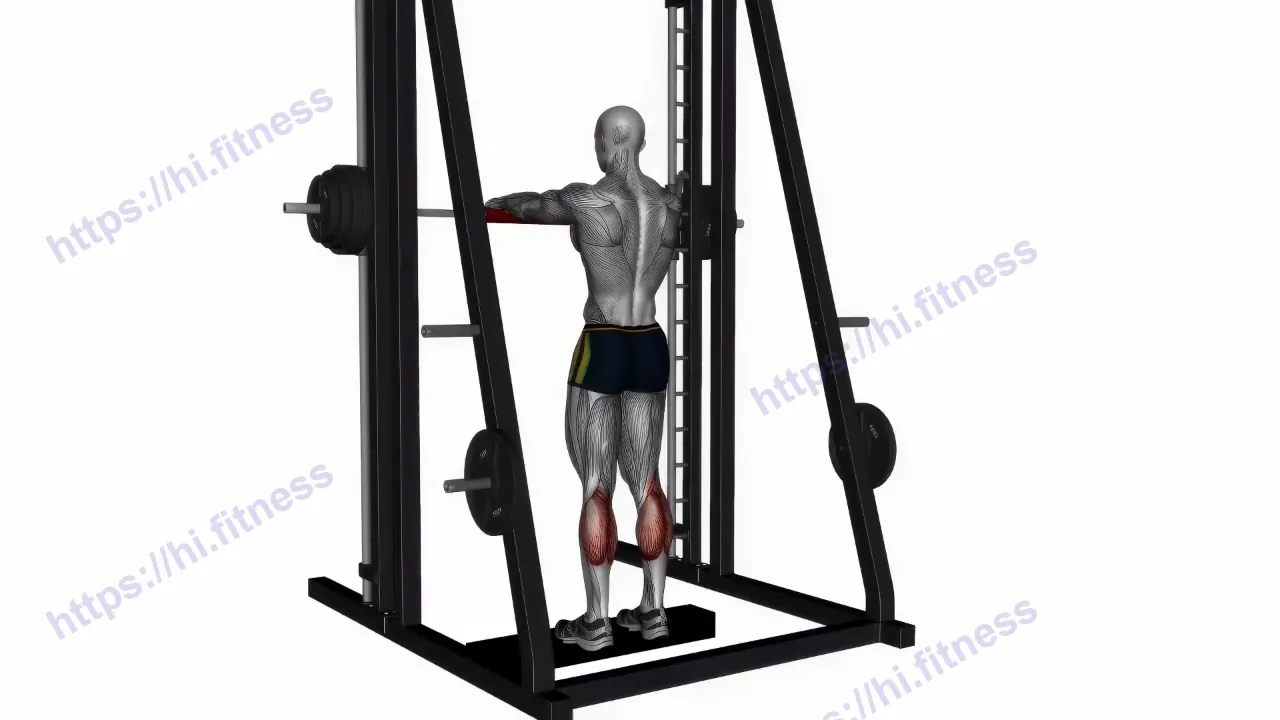
The list is short, because a Smith machine does not add new movement patterns - it takes the balancing out of the ones you already know from the barbell. What you will find here is the handful of positions where that difference actually changes something: pressing at three bench angles, the overhead press, the Bulgarian split squat, inverted rows and calf raises. Look for the rest on the barbell side.
Smith machine exercises by muscle group
Pick the muscle group you want to train and see which exercises cover it.


More muscle groupsMid chest 1·Quads 1·Upper back 1
Exercise library
All Smith machine exercises
8 exercisesFilters
Filters
Training type


Training guide
About training Smith machine exercises
Choose one movement, perform it well, then progress it over time.
Why such a narrow selection?
Because a Smith machine is one station, not a separate family of exercises. A bench press in rails is still a bench press, a squat is still a squat, a row is still a row. What sits here in the atlas is only the positions where the rails change something real, and not just the name.
There is also a mechanical reason the list leans toward presses. The rails take away your feet's ability to adjust to the weight. On a press that costs nothing, because your feet are planted anyway. On a squat and a deadlift your feet have to find the position where the weight lines up over the middle of the foot, and a vertical rail does not let them. For a lot of people that ends in a stance that would make no sense in a free squat.
The Bulgarian split squat is the exception here, and it shows nicely what the rails are really for. In the barbell or dumbbell version a set often ends because balance on the front leg ran out, not strength. A bar held by the rails removes that limit.
What do the rails give you, and what do they take away?
They give you two things. The weight cannot escape anywhere off vertical, so your attention stays on pushing. And you have hooks along the whole length: a rep that does not go up ends with a turn of the wrist, no partner and no bailing out from under a bar on your chest. For people who train alone that is usually the strongest argument for the Smith machine.
They take away stabilization and adjustment. The muscles that hold the path on a free barbell have the whole time off here, so the carryover of your result to free weights is partial. Your shoulder and hip also have to travel a line somebody else drew. If pressing in a Smith machine irritates your shoulder and dumbbells do not, the fixed path is usually what is responsible, not the weight itself - and then it is smarter to change equipment than to wait it out.
Inverted rows are worth remembering separately, because they are the one position on this list where the rails are entirely on your side. You lock the bar at any height, and that height is the difficulty dial here: the lower you set the bar, the more of your body weight hangs on your arms.
Explore further
Browse the exercise library
Browse by muscle
Upper chest·Mid chest·Lower chest·Lats·Upper back·Lower Back·Front delts·Side delts·Rear delts·Biceps·Triceps·Forearms·Quads·Hamstrings·Glutes·Calves·Core
Browse by equipment
Bodyweight·Dumbbell·Bench·Barbell·Resistance band·Cable·Machine·Squat rack·Other·Mat·Box·Suspension trainer·Stability ball·Kettlebell·Cardio machine·Pull-up bar·EZ bar·Ab wheel·Weight plate·Roman chair·Smith machine·Dip bars·Jump rope·Medicine ball
Browse by type
Add this exercise to a workout and track your progress
Add it to a plan or to your current session, log sets, weight and reps, keep the instructions and tips at hand while you train, and check your previous results, records and volume.
- Plan - add this exercise to a workout
- Log - sets, weight and reps
- Progress - history, records and volume