Equipment
Barbell quad exercises
The barbell is the only piece of equipment where your legs get everything they can actually lift. Legs are stronger than grip, so any load held in your hands gives out before the muscle does. A bar sitting on your shoulders skips that ceiling, and that is why most leg progress gets written down here.
The variable on this list is not the weight, though. It is where the bar sits. The higher and further forward it rides, the more upright your torso has to stay and the less work the hips can take over. Front squat, high bar, low bar and Zercher are the same leg movement with four different demands on everything else.
Exercise library
All Barbell quad exercises
1 exerciseFilters
Filters
Clear filters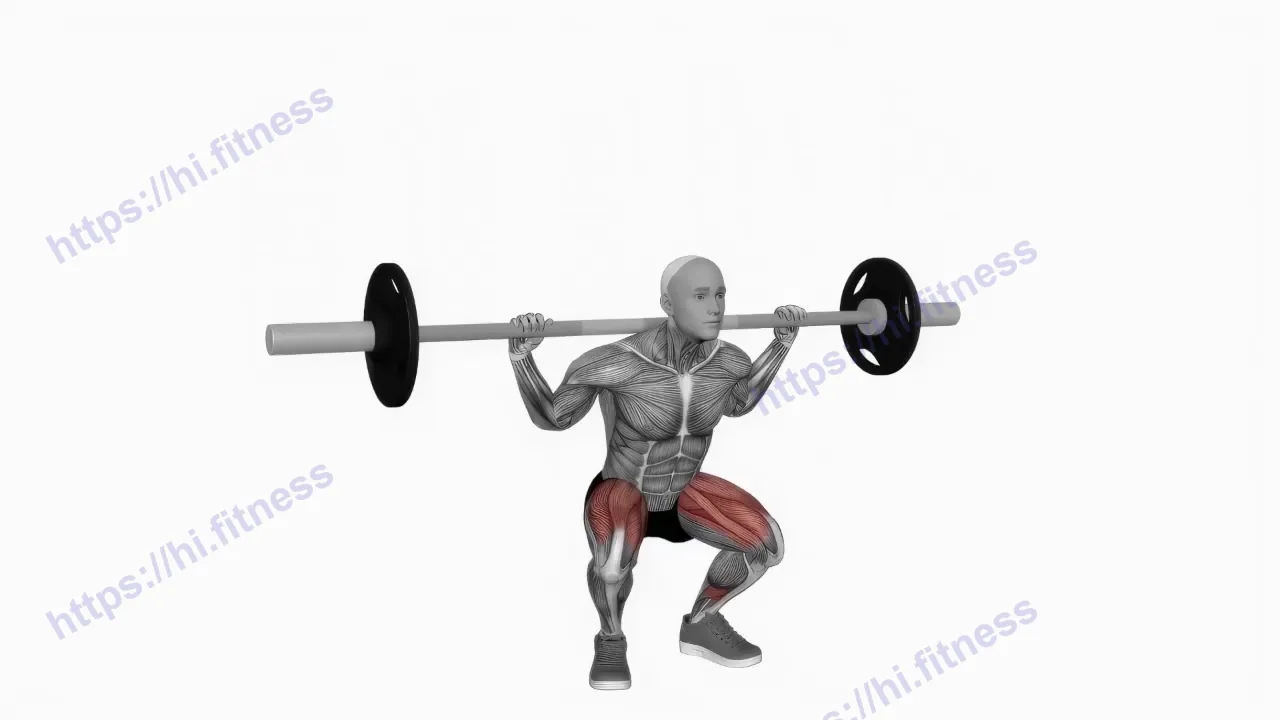
Training guide
About training Barbell quad exercises
Choose one movement, perform it well, then progress it over time.
What decides how much the quads get?
Bar placement. A bar riding high on the traps lets you keep the torso reasonably upright. Drop it lower, onto the rear delts and the shelf below, and you are forced to lean further forward, which hands part of the work to the hips and glutes - which is why low bar usually moves more weight with less of it landing on the quads. The front squat goes the other way as far as it goes: the bar sits on the front of your shoulders, so any forward lean means the bar comes off. The torso has to stay vertical, the knee travels further past the foot, and the quads have nobody to share the job with.
The second variable is stance width. A narrow stance closes the hips down and leaves more for the knees; a wide or sumo stance opens them up and pulls in the adductors and glutes. The atlas carries both extremes with a barbell, including a feet-together version, so you can run the comparison on your own legs inside a single session.
The exotic variations run on the same mechanism. The Zercher squat holds the bar in the crooks of your elbows, lower still and further forward still, and the overhead squat demands the most vertical torso of the lot - except there the limit is shoulder mobility, not leg strength.
Which of these are not really quad exercises?
Cleans, snatches and clean pulls. They land here because the knee extends under load in every one of them, but the technique notes name the real source of the power themselves: explosive hip extension. The quads do work catching the bar and standing up out of the receiving position, but what caps the weight in these lifts is technique, grip and back, not the quads.
That is not an argument against doing them - they are some of the most demanding entries in the whole atlas. It only means that if you are counting quad volume, count squats, lunges and step-ups, and treat the clean as its own line in the plan.
Thrusters and clusters are their own case. They are a squat welded to an overhead press, so the legs genuinely work; you just pick the weight for your shoulders. As conditioning they are excellent. As a stimulus for the quads they are capped by the weakest link, and the weakest link is not your legs.
Progress the movement
Settle the depth first
On legs it is range, not the number on the bar, that decides whether you are still doing the same exercise. As long as the bottom position moves from set to set, comparing weights measures nothing.
Add less than feels sensible
A 2.5 kg jump looks like nothing on a squat, because it is a fraction of what is already loaded. That is exactly why you can repeat it for weeks, while 10 kg jumps stall after two or three.
Move the bar instead of adding plates
The same weight carried on the front of your shoulders instead of your back is noticeably harder on the quads. That is a form of progress no other piece of equipment offers.
Explore further
Workout tracker
Add this exercise to a workout and track your progress
Add it to a plan or to your current session, log sets, weight and reps, keep the instructions and tips at hand while you train, and check your previous results, records and volume.
- Plan - add this exercise to a workout
- Log - sets, weight and reps
- Progress - history, records and volume