Equipment
Front delt exercises with a resistance band
At the shoulder a band is a different tool than it is on bigger muscles. The list is short and clearly tilted toward preparation work: alongside the overhead press and front raises you will find Y and T raises, external rotations, and a stretch into the front rack position.
That is no accident. A band's resistance grows as it stretches, so it is lightest at the start of the movement and heaviest at the top, with your arms fully extended. For the small muscles around the shoulder joint that layout is convenient. For heavy pressing, far less so.
Exercise library
All Front delt exercises with a resistance band
2 exercisesFilters
Filters
Clear filters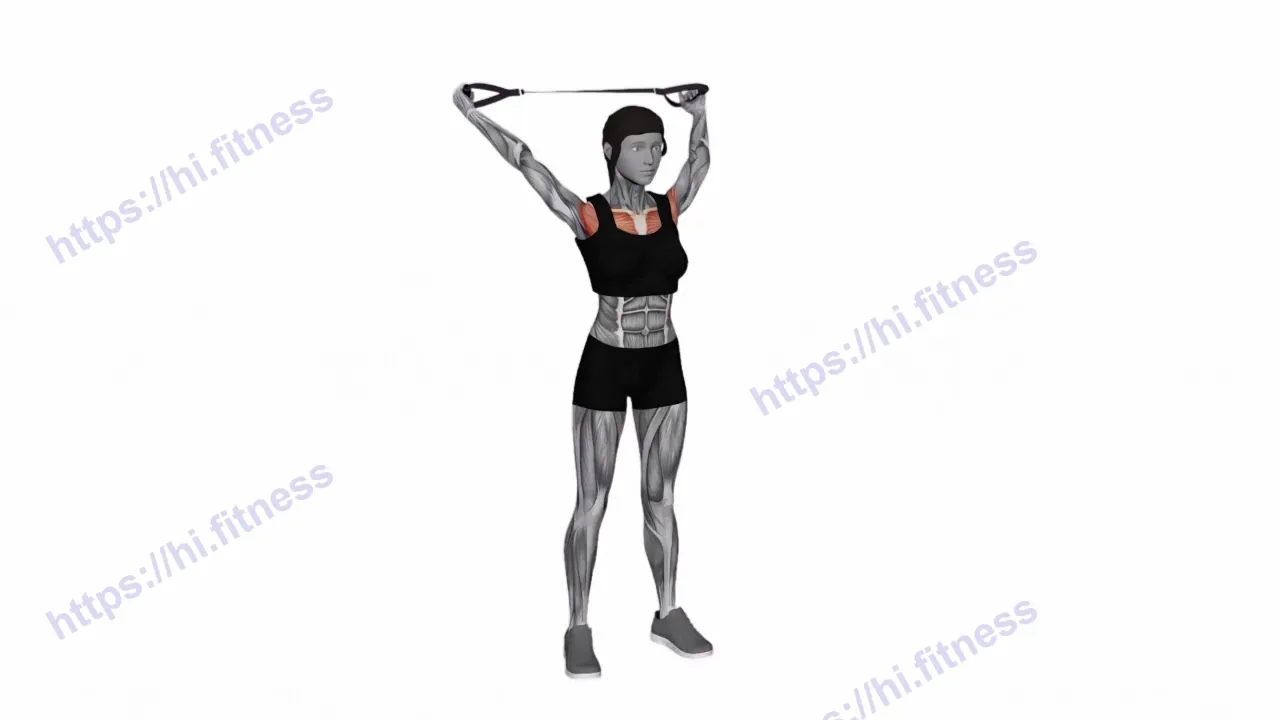

Training guide
About training Front delt exercises with a resistance band
Choose one movement, perform it well, then progress it over time.
What is a band best at around the shoulder?
Everything that comes before the heavy work, and everything that comes after it. External rotations, Y and T raises and the stretch into a front rack are movements where control and small, even resistance are what count, not load. A band gives exactly that and fits in a pocket.
It also works as the only equipment you travel with. An overhead press with the band anchored under a bench or under your foot is the same movement pattern as with a barbell, with one difference: the hardest part lands at the top, as your arms straighten. The set ends on the lockout, then, not on the drive off your shoulders.
It does well as a finisher after heavy pressing too, when there is nothing left for another set of dumbbells but you can still hold light resistance through a full range.
What will a band not do?
It will not stand in for weight where overhead pressing strength is the point. With a barbell or dumbbells the hardest part sits just above your shoulders, in the bottom of the movement, and that is where the rep breaks down. With a band it runs the other way: the bottom is light and the resistance only builds higher up. So you are mostly training the finish of the movement, not the piece that usually decides the outcome.
Same story with front raises. With a dumbbell the hardest moment arrives when your arm is parallel to the floor, because that is where the lever is longest. A band anchored under your foot pushes that peak higher, above shoulder line, where the traps are already joining in. Same movement, different place for the hardest effort.
None of which means a band does not work. It means it works somewhere else, and at the shoulder that trade comes out better than at any other muscle, because half of what this joint needs is light, controlled work through a full range anyway.
Progress the movement
A solid anchor first
As long as the band creeps under your foot or slides off the bench, two sessions in a row are not comparable. That is the first thing to sort out, not a detail for later.
Step away from the anchor
You load a band with geometry. A step further from the anchor, a shorter grip, or a wider stance raises the resistance across the whole range, without buying anything.
Keep a separate band for rotations
Pressing and the rotator cuff move at completely different speeds and need different resistance. Two bands let you run them independently, instead of hunting for a compromise that fits neither.
Explore further
Workout tracker
Add this exercise to a workout and track your progress
Add it to a plan or to your current session, log sets, weight and reps, keep the instructions and tips at hand while you train, and check your previous results, records and volume.
- Plan - add this exercise to a workout
- Log - sets, weight and reps
- Progress - history, records and volume