Equipment
Chest exercises with a resistance band
A band gives the chest something weight can't: resistance that grows as it stretches. The hardest point is the moment your hands come together in front of your chest, which is exactly where a barbell and dumbbells get lightest. The second difference is direction - a band can be pulled across your body and on a diagonal, not just up and down relative to the floor.
Almost everything on this list depends on one thing that is easy to forget when you buy a set: the anchor point. It decides whether you are doing flyes high to low, low to high, or a press at chest height. Without a solid anchor you are left with a handful of movements where the band runs under a bench or sits behind your back.
Exercise library
All Chest exercises with a resistance band
12 exercisesFilters
Filters
Training type

Band Bench Press
Mid chest · Resistance band

Resistance Band Assisted Push-up
Mid chest · Resistance band

Chest Fly Low to High Resistance Band
Mid chest · Resistance band

Band High Fly
Mid chest · Resistance band

Band Low Alternate Chest Press
Mid chest · Resistance band

Band Single Arm Pec Fly
Mid chest · Resistance band
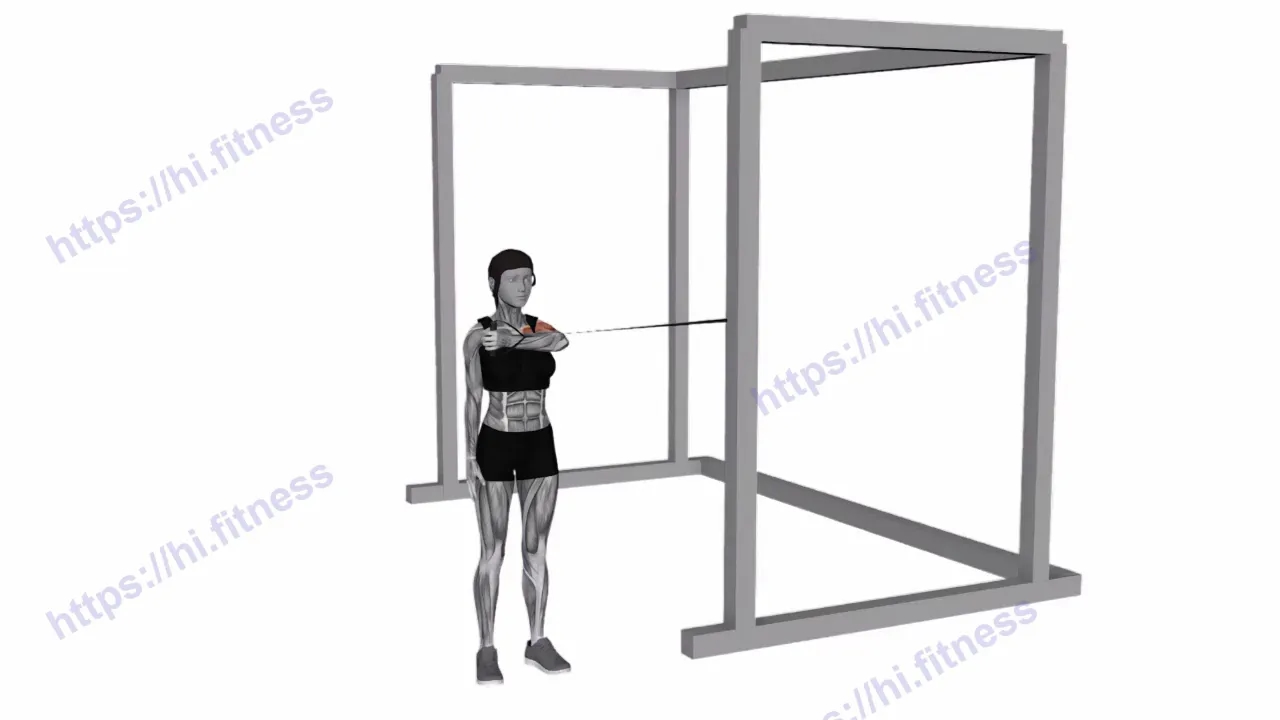
Band Cross Body One Arm Chest Press
Mid chest · Resistance band

Floor Cable Resistance Band Press
Mid chest · Resistance band

Resistance Band Shoulder Adduction
Mid chest · Resistance band
Training guide
About training Chest exercises with a resistance band
Choose one movement, perform it well, then progress it over time.
Where is a band hardest?
At the end of the movement. Latex resistance climbs as it stretches, so the closer your hands get, the harder they are to hold there. That is the reverse of a bench press, where the bottom is hardest and the top unloads itself. The practical takeaway is to treat a band as a tool for working the squeeze, not for loading the chest in a stretch - dumbbells are what does that.
For the same reason the descriptions keep coming back to a slow return. The band wants to shorten itself, and if you let it, half the set disappears in a few seconds. The phase where the arms travel back out to the sides is the only one where you have full control of the tempo.
The flip side of that mechanic is a dead start. If the band is slack in the starting position, the first stretch of the path passes with no resistance at all and the chest only starts working halfway through. Stepping a pace or two away from the anchor kills that problem faster than any technique cue.
What does the anchor point set?
Anchor height decides the angle, and the angle decides which part of the chest gets the most. Anchored low near the floor means a movement from the bottom up, with your hands meeting at head height. Anchored high gives you a movement from the top down, finishing in front of your lower abdomen. Anchored at chest height is the classic press straight ahead, the closest thing to what you do on a bench. The catalog has all three as a fly and as a press, so even if you have one anchor point at home and it sits at a fixed height, you are still left with several different movements.
Not every variation needs an anchor. The flat bench press is done with the band run under the bench, and then the only condition is that it doesn't slide out mid-set. It is the closest equivalent of a barbell bench press you can build out of a set of bands alone.
There is also one use no other equipment on this list has: a band can make an exercise easier instead of harder. Push-ups with a band anchored to a pull-up bar and looped across your shoulders take load off you in the bottom phase, which is where a push-up is hardest. If a full push-up isn't there yet, that is a smarter step than dropping to your knees, because the range of motion stays full.
Progress the movement
Pause where your hands meet
The band is strongest when your hands are closest together. A short pause there is noticeably harder than the same rep done smoothly, and it needs no extra equipment.
Step further from the anchor
Every step forward lengthens the band and raises the resistance across the whole range, the start included. That is your version of adding plates - write down how many steps you take, or there is no way to compare one session with the next.
Move the band onto one arm
One-arm flyes and the press across the body are separate entries in the atlas. The same band on one arm is twice the resistance on that side, and the torso has to start defending itself against rotation.
Explore further
Workout tracker
Add this exercise to a workout and track your progress
Add it to a plan or to your current session, log sets, weight and reps, keep the instructions and tips at hand while you train, and check your previous results, records and volume.
- Plan - add this exercise to a workout
- Log - sets, weight and reps
- Progress - history, records and volume