Equipment
Ab exercises with dumbbells
A dumbbell does not change what the abs do. It changes how much they have to do. The list splits into two clear groups here: crunches and sit-ups, where you hold the weight somewhere above the torso, and movements where a single dumbbell in one hand drags you sideways and the torso's job is not to give in to it.
Next to the no-equipment list this one is short, and it will stay short, because lying on your back there are not many places you can sensibly hold a dumbbell. The whole choice really comes down to two questions: how far from your hips you hold the weight, and whether it is in one hand or both.
Exercise library
All Ab exercises with dumbbells
1 exerciseFilters
Filters
Clear filtersTraining type
Training guide
About training Ab exercises with dumbbells
Choose one movement, perform it well, then progress it over time.
Why add weight to crunches at all?
Abs are a muscle like any other and they respond to resistance. Without it a set usually ends when your patience runs out, not your strength. With a dumbbell it fits inside a rep count you can remember and compare with last week.
That does not mean there is no progress without one. With no equipment you adjust the difficulty with the lever of your own legs and arms, and that road is a long one. A dumbbell is simply a simpler version of the same principle: instead of hunting for a harder variation, you move the same weight further from your hips or pick up a heavier one.
The limit is often the grip and the shoulders. In sit-ups with a dumbbell overhead it is rarely the abs that quit first, because the arms holding the weight in one spot tire sooner. Versions with the dumbbell held on the chest usually let you use noticeably more load.
Why one dumbbell in one hand?
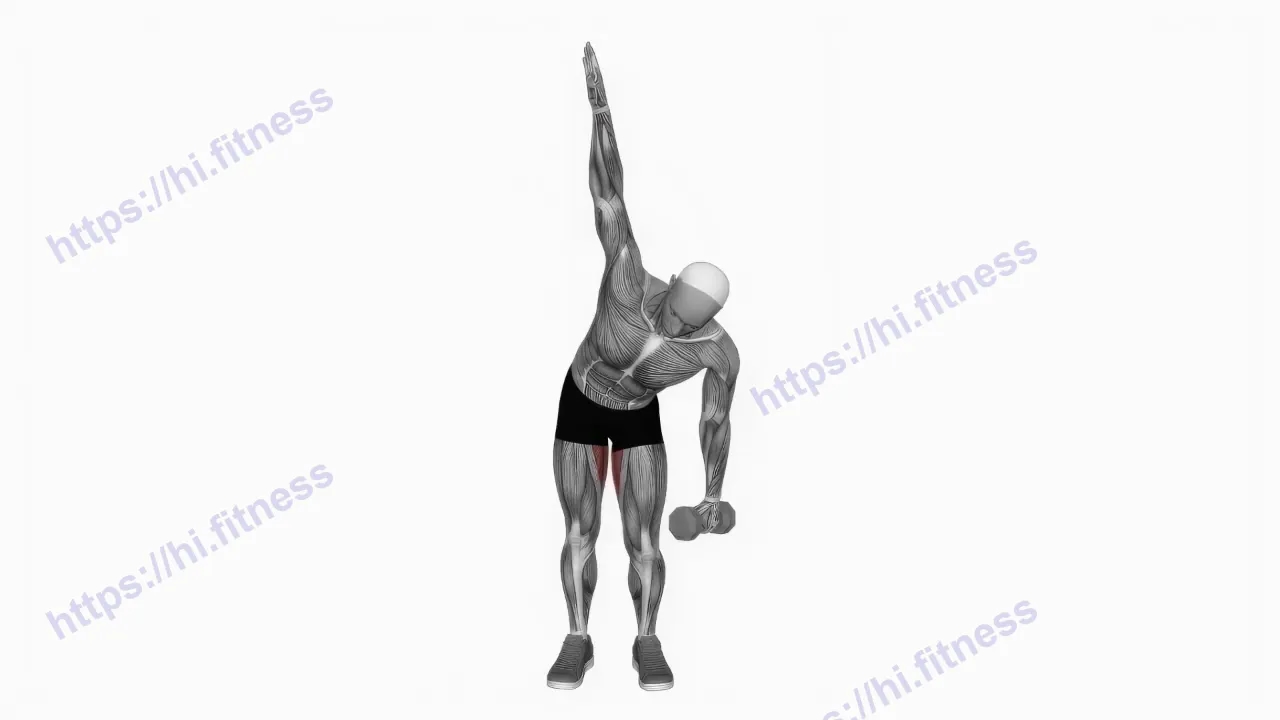
Because it is the simplest way to load the abs unevenly. A carry with a dumbbell at one side, the side bend, the windmill and the side plank with a dumbbell all put the torso in a situation where the weight drags it one way and the muscles on the other side have to refuse. In a gym a cable does this; at home a pair of dumbbells is the closest equivalent.
That work looks unremarkable, because almost nothing moves. A one-arm carry does not even have reps: you walk straight ahead at an even pace and keep the dumbbell from swinging and the torso from leaning. The effort only becomes obvious once the weight gets serious, and at that point it is usually the grip that gives out first.
The side bend and the diagonal chop belong to the same family, only with movement. The first runs the obliques through a full range in the side plane; the second combines rotation with a lean and asks you to turn your feet along with the torso, so the hips and knees don't get left behind.
Progress the movement
Start with the dumbbell on your chest
Held close to the hips the weight is easiest to control, and it lets you learn the movement before the lever starts to make a difference.
Move it away from your hips
The same dumbbell on straight arms, and then overhead, loads the abs clearly harder without adding a kilo. Given that the jump between pairs of dumbbells can run to 2 kg, that is much finer control.
Switch it into one hand
The one-arm versions, like the carry at your side, the starfish crunch or the side plank with a dumbbell, change the job: the abs stop bending the torso and start keeping it from tipping.
Explore further
Workout tracker
Add this exercise to a workout and track your progress
Add it to a plan or to your current session, log sets, weight and reps, keep the instructions and tips at hand while you train, and check your previous results, records and volume.
- Plan - add this exercise to a workout
- Log - sets, weight and reps
- Progress - history, records and volume